Pilates Teacher Training: 5 Best Certifications for 2026
With a projected 15% job growth rate over the next five years, Pilates instructors have an estimated average of $69,000 gross annual salary. Pilates certification is on the rise, to no surprise.
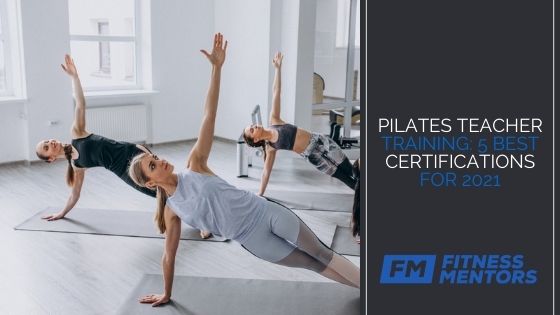

Top 5 Best pilates training programs online
- International Sports Sciences Association (ISSA) – Pilates Instructor Certification
- Balanced Body – Pilates Instructor Training
- Basi Pilates – Pilates Instructor Training
- Core Pilates – Pilates Instructor Course
- Peak Pilates – Pilates Instructor Certification
- Power Pilates – Comprehensive Pilates Certification
If you’re passionate about mind and body wellness and hope to spread the message to those unfamiliar with the concept, check out the five best Pilates instructor certifications below. We’ll give you a rundown of the prerequisites, pricing and program lengths of each to help you determine which is right for you.


What Is Pilates Teacher Training and Do You Actually Need Certification?
Unlike personal training, Pilates instruction is not federally regulated which means you technically could teach without a certification. But here’s the reality: reputable studios, gyms, and clients expect and require certified instructors. Certification signals credibility, competence, and commitment to safety.
The Pilates Method Alliance (PMA) recommends a minimum of 450 hours of training for a comprehensive certification. Their NCPT (National Certified Pilates Teacher) exam is the gold standard for independent, third-party credentialing and many of the programs below prepare you for it.
Top Pilates Certifications at a Glance
Use this overview to quickly compare your options before diving into the details below.
Certification | Price | Duration | Best For | Format |
ISSA Pilates | $799 | 8–10 weeks | Online learners / fitness pros | 100% Online |
Balanced Body | $400–$500/module | 134–520 hrs | Modular learners | In-person |
Basi Pilates | $4,198 | Up to 3 years | Classical + biomechanics | In-person |
Core Pilates NYC | $5,495 | 6 months / 600 hrs | Classical immersion NYC | In-person |
Peak Pilates | $4,579 | 500 hrs | Structured 3-level path | In-person |
Power Pilates | $4,995 | 6–12 months / 600 hrs | Comprehensive classical | In-person |
The 6 Best Pilates Teacher Training Programs for 2026
1. ISSA Pilates Instructor Certification – Best for Online Learners
The ISSA Pilates certification is the most accessible entry point for aspiring instructors. As a fully online, self-paced program with no prerequisites, it works especially well for fitness professionals looking to add a Pilates specialty to their existing credentials.
Prerequisites
None. This is open to anyone regardless of prior fitness or teaching experience.
Program Length & Format
Self-paced; typically 8–10 weeks depending on your schedule. Entirely online study guides, quizzes, and a final exam are all completed digitally. ISSA’s on-staff professors provide ongoing support via an online student forum.
What You’ll Learn
- Human anatomy and physiology specific to Pilates movements
- Foundational and advanced Pilates exercises and cueing
- Session design and class programming
- Safety principles and contraindications
- Modifying exercises for individual client needs and goals
Price
Regular price: $799. Discounts and promotions are frequently available visit the ISSA website for current pricing.
Who It’s Best For
Personal trainers, group fitness instructors, or yoga teachers who want to add Pilates mat work to their offering quickly. Because this is primarily a mat-focused certification without apparatus hours, it is ideal as a starting point or add-on not as a standalone qualification for working in dedicated Pilates studios.
Editor’s Note | I’ve personally reviewed the ISSA curriculum and rate it as one of the most well-structured online Pilates certifications available. The accessibility and price point make it an excellent starting point. |
2. Balanced Body Pilates Instructor Training - Best Modular Program
Balanced Body blends traditional and contemporary Pilates into a four-module curriculum that can be completed at your own pace one module at a time. This flexibility makes it ideal for people who want to start teaching sooner while continuing to deepen their training.
Program Structure
- Mat Instructor Training — 134 hours
- Reformer Instructor Training — 214 hours (anatomy not included)
- Mat & Reformer Instructor Training — 332 hours (anatomy not included)
- Comprehensive Instructor Training — 520 hours (anatomy not included)
Prerequisites by Module
- Mat: 10 Pilates mat sessions; 6 months related experience (recommended)
- Reformer: 20 Reformer sessions; 1 year related experience; anatomy required
- Mat & Reformer: Same as Reformer
- Comprehensive: 20 Pilates studio sessions; 1 year experience; anatomy required
Price
Modules range from $400–$500 each; manuals ~$50; videos ~$10 each. Bundle pricing is available contact Balanced Body directly.
Who It’s Best For
Career changers who want to start generating income quickly (by completing the mat module first) while building toward a comprehensive certification over time. Also strong for those who want formal recognition on the Balanced Body website upon completion
3. Basi Pilates Comprehensive Program - Best for Anatomy & Biomechanics
The Basi Pilates program is built on a deep anatomical and biomechanical foundation. Split into a Foundation Program and a Graduate Program, it produces instructors who can confidently teach advanced-level students and work with special populations.
Program Structure
Foundation Program (6 modules): Intermediate-level Pilates fundamentals. Graduate Program (6 modules): Advanced equipment, methodology, and teaching evaluation.
Prerequisites
- Completion of both Foundation and Graduate Programs
- Minimum 100 observation hours, 200 self-practice hours, 200 student teaching hours
- Passing grade on the final practical exam, teaching evaluation, and term paper
Price
Both programs combined: $4,198 (includes deposits and admission fees). Additional $250 per program for practical exam and teaching evaluation. $200 discount when purchasing both programs simultaneously.
Program Length
All requirements must be completed within 3 years to qualify for final assessments.
Who It’s Best For
Instructors who plan to work in clinical or rehabilitation-adjacent settings where deep anatomical knowledge is essential.
4. Core Pilates NYC Comprehensive Course - Best Classical Immersion
Core Pilates NYC offers one of the most intensive classical Pilates educations available, grounded in the original Joseph Pilates method. At 600 hours and 6 months, this is a serious commitment and a serious credential.
Learning Format
Physical classes, instructional videos, manuals, quizzes, and interactive discussions with instructors and classmates. You progress from beginner anatomy and movement principles through advanced apparatus work and apprenticeship.
Prerequisites
10 private, 10 semi-private, and 10 apparatus sessions (not included in tuition). These can be purchased as a Career Starter Kit bundle.
Price
- Full program tuition: $5,495 (includes apprenticeship, Anatomy in Clay, Small Equipment & Special Cases, lifetime online platform access)
- Career Starter Kit (30 prerequisite sessions): additional $1,536
Program Length
5 intensive weekends; 6-month commitment total.
Who It’s Best For
Serious career changers based in or near New York City who want to teach at high-end classical studios, work one-on-one with clients, or eventually open their own studio
5. Peak Pilates Comprehensive Certification - Best Structured 3-Level Path
Peak Pilates takes a systematic, three-level approach to instructor training covering mat, Reformer, apparatus, and auxiliary equipment through a curriculum centered on Pilates as an integrated mind-body system.
Prerequisites
- Level 1 Entry: basic anatomy and kinesiology knowledge, 20 hours of Pilates training, CPR/AED and first aid certification
- Completion: all levels, all logged hours, and all assessments passed
Price
$4,579 total, including all individual course materials.
Program Length
500 hours total (including course contact and logged hours).
Who It’s Best For
Learners who prefer a clearly defined progression path with distinct milestones at each level. The three-tier structure makes it easier to plan your study schedule and track advancement.
6. Power Pilates Comprehensive Pilates Certification - Most Flexible Schedule
Power Pilates covers everything from beginner mat work through advanced apparatus training in a program you can take all at once or split across three advancement levels making it ideal if you need to balance training around an existing job or family commitments.
Prerequisites
- Minimum 25 apparatus sessions (classically trained instructor preferred)
- Power Pilates Core Mat I and Core Mat II completion
- Basic anatomy knowledge related to movement
Price
$4,995 (US program), including manuals, weekend training, apprentice meetings, and exams.
Program Length
6–12 months (600 hours), including weekend intensives and apprenticeship requirements.
Who It’s Best For
Working professionals who need scheduling flexibility without sacrificing depth of training. The split-level option lets you earn partial credentials and start teaching sooner while continuing toward full certification
How to Become a Certified Pilates Instructor: Step-by-Step
Here is a realistic roadmap from complete beginner to working instructor.
Step 1: Take Pilates Classes as a Student
Before enrolling in any program, become a dedicated student. Most programs require documented session hours as a prerequisite. This also helps you determine which method classical or contemporary resonates with your teaching philosophy.
Step 2: Choose Your Certification Path
Decide whether you want to specialize first (mat or Reformer only) or go comprehensive. If you’re switching careers full-time, comprehensive training gives you the most teaching opportunities. If you’re adding a specialty alongside another role, a focused certification like ISSA makes more sense.
Step 3: Meet Prerequisites and Enroll
Gather your documented practice hours, anatomy requirements, and any CPR certifications required by your chosen program. Then enroll and commit to the schedule.
Step 4: Complete Training Hours
Comprehensive programs average 500–600 hours, including observation hours, self-practice hours, and student teaching hours. Expect 1–2 years of part-time study if you’re working alongside the training.
Step 5: Pass the NCPT Exam (Optional but Recommended)
After completing your training, you’re eligible to sit for the NCPT (National Certified Pilates Teacher) exam administered by the Pilates Method Alliance. This independent, nationally recognized credential signals the highest level of professional competency and can be taken remotely. It is separate from your training school’s certificate.
Step 6: Find Your Niche
Once you begin teaching, identify your strengths. Do you excel at group Reformer classes or one-on-one private sessions? Are you drawn to athletes, prenatal clients, or rehabilitation? Narrowing your focus over time makes you more referable and lets you charge higher rates.
Can You Make a Living as a Pilates Instructor? (Honest Answer)
Yes, but let’s be specific about what that looks like.
Average Income
Certified Pilates instructors earn an average gross annual salary of approximately $69,000. Instructors who pursue advanced or multiple certifications can earn up to 27% more per year.
Income Ceiling Reality
In-person teaching has an inherent hourly cap you can only teach so many clients per day. Large group Reformer classes (6–12+ students) generate significantly more revenue per hour than private sessions. Studio ownership with additional teachers is a different income model entirely.
Hidden Costs of Self-Employment
- Health insurance: $300–$500/month in the US
- Quarterly tax set-asides (self-employment tax)
- Continuing education (required for most certifications)
- Marketing, website, and client management tools
- Liability insurance
If you are employed by a studio, these costs shift to the employer but your hourly rate will be lower. Employers who offer full benefits to Pilates instructors are rare; prioritize them if you find one.
Building a Full Client Load Takes Time
Plan for approximately one year of dedicated effort to build a full-time teaching schedule. During that ramp-up period, maintaining another income source is wise. Once established, many instructors run waiting lists.
Pros and Cons of Being a Pilates Teacher
Pros
- Flexible schedule — design your hours around your life and commitments
- Broad teaching opportunities — studios, gyms, yoga spaces, dance studios, your own rented space
- Personal health benefits — instructors maintain elite body awareness and physical wellbeing as a byproduct of the work
- Longevity — you can teach well into your 70s and 80s (Joseph Pilates himself is a famous example)
- Deep client impact — the improvements clients make follow them for life, far beyond the studio
Cons
- Income cap — in-person teaching has limits without scaling into groups or online delivery
- Self-employment responsibilities — taxes, marketing, and administration fall on you
- Schedule demands — most clients want early mornings, evenings, and weekends, especially while you’re building clientele
- Physical and mental load — a full client schedule is demanding; plan for recovery time, especially if you’re introverted
Business-building lag expect 6–12 months before reaching a comfortable full-time income
Online vs. In-Person Pilates Teaching: Which Path Is Right for You?
The rise of online fitness has opened a new income stream for Pilates instructors that removes the geographic and hourly cap of in-person teaching.
In-Person Teaching
Best for: building deep client relationships, working with special populations and rehabilitation clients, and classical apparatus-based instruction that requires hands-on cueing.
Online Teaching
Best for: scaling income beyond hourly limits, reaching clients worldwide, and creating passive income through recorded programs. Requires additional skills in video production, digital marketing, and online platform management — but removes geographic limitations entirely.
Hybrid Model
Many successful instructors combine both: in-person privates and small groups for premium clients, plus online group classes or recorded content for broader reach. This is increasingly the standard for instructors earning well above the average salary.
Frequently Asked Questions
What is the best Pilates certification for 2026?
There is no single ‘best’ — the right program depends on your goals, budget, and schedule. For speed and accessibility: ISSA ($799, online, no prerequisites). For the most job opportunities and comprehensive training: Power Pilates or Core Pilates NYC (600 hours, classical method). For a structured level-by-level path: Peak Pilates. For modular flexibility: Balanced Body.
How long does it take to become a certified Pilates instructor?
A basic mat certification can be completed in 8–10 weeks (ISSA). A comprehensive certification covering all apparatus and qualifying you for the NCPT exam typically takes 1–2 years of part-time study and 500–600 logged hours.
What is the NCPT exam and do I need it?
The NCPT (National Certified Pilates Teacher) is an independent credentialing exam administered by the Pilates Method Alliance. It is separate from your training school’s certificate and demonstrates mastery beyond any single program’s standards. It is not mandatory, but it signals the highest level of professional credibility and is increasingly expected at premium studios.
Can you become a Pilates instructor online?
Partially. The ISSA certification is fully online and a legitimate starting point. However, comprehensive certifications require in-person hours for apparatus training, observation, and student teaching these components cannot be fully replicated online.
How much do Pilates instructors make?
The average gross annual salary is approximately $69,000. Instructors with advanced certifications can earn 27% more. Self-employed instructors should account for health insurance ($300–$500/month), taxes, and business expenses when calculating net income. Group Reformer classes generate significantly more revenue per hour than private sessions.
Do I need prior fitness experience to enroll in Pilates teacher training?
Not for all programs. ISSA has no prerequisites. Most comprehensive programs require documented Pilates sessions (10–25) and recommend anatomy knowledge. Some require CPR/AED certification before enrollment or completion.
Is it worth becoming a Pilates instructor?
Yes, if you are genuinely passionate about movement and helping people. The career offers flexibility, longevity, and deep personal fulfillment. Go in with realistic income expectations, plan for a 6–12 month build phase, and invest in comprehensive training that opens the widest range of teaching opportunities.

Eddie Lester
Read more from the category
Altered Reciprocal Inhibition: Essential Techniques for Beginners
Running Coach Certification: Which Is Best For You?