How Personal Trainers Will Know When They’re Ready to Open a Gym
Thinking about opening a gym? This guide walks personal trainers through the financial benchmarks, personal traits, and business skills you need before making the leap from employee to gym owner.
Opening a gym is the goal that lives quietly in the back of many personal trainers’ minds. You’ve spent years building expertise, earning client trust, and developing your training style and at some point, the idea of building something of your own starts to feel less like a dream and more like a logical next step.
But knowing when you’re truly ready is not just a gut feeling. It requires an honest assessment of your financial situation, your personal drive, and whether you have or can acquire the business skills needed to sustain a fitness business beyond the first year.
This guide covers the three core pillars of gym ownership readiness for personal trainers: financial development, personal development, and business skillsets. By the end, you should be able to answer the questions that actually matter before signing a lease or registering an LLC.
Four Questions to Answer Before Opening a Gym
- Do I know my estimated monthly operating costs in detail?
- Is my current client revenue strong enough to sustain both my income and early business expenses?
- Do I genuinely have the drive, resilience, and personality traits that entrepreneurship demands?
- Do I have the core business skills to run a gym, or can I afford to outsource the ones I lack?
If you cannot answer these with confidence right now, keep reading. That’s exactly what this guide is for.
Who This Guide Is Written For
Before we dive in, let’s establish who this guide is aimed at. We’re assuming:
- You’re planning to open a small studio, specialty gym, or private training facility not a large commercial box gym.
- You’re currently a solo trainer or part of a small team and are ready to stop working under someone else’s roof.
- You have a defined fitness niche CrossFit, yoga, Pilates, sports performance, strength training, weight loss, martial arts, or similar.
- You’re thinking 1–3 years out. Opening a gym is a planned process, not an impulse decision.
- You already have a consistent client base you’d bring with you.
If you’re still building your clientele or haven’t yet identified your niche, that’s your first priority not a lease.
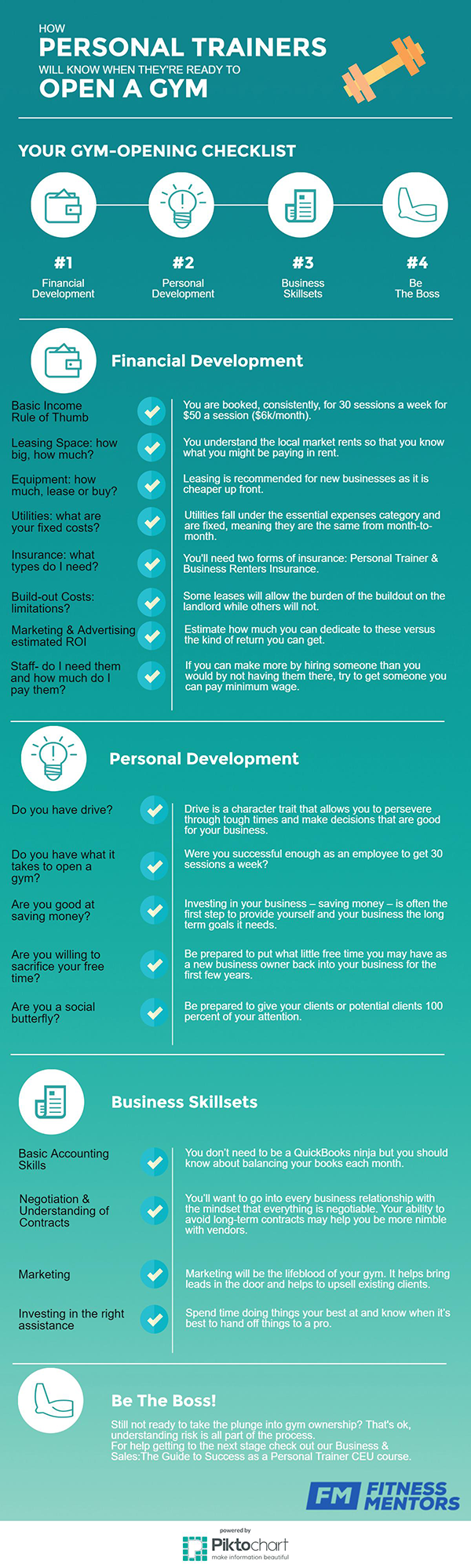
Part 1: Financial Readiness for Opening a Gym
Money is where gym ownership dreams most often hit a wall. The good news for personal trainers: you already have a built-in revenue stream from your clients. The challenge is understanding exactly how much you need to earn before adding the overhead of a physical space.
The Minimum Income Benchmark
A practical rule of thumb for trainers considering a small gym: you should be consistently booking at least 30 sessions per week at your going rate. At $50 per session, that’s approximately $6,000 per month in gross income.
Why $6,000/month? Because in a lean early-stage gym model, a meaningful portion of your income will go back into the business. You need enough left over to cover your own living expenses without dipping into business capital.
Note that this figure varies significantly by location. In a high-cost market like New York City or San Francisco, $6,000/month may barely cover rent. In lower-cost markets in the Midwest or South, the same income gives you considerably more runway.
Startup Costs to Plan For
1. Leasing Commercial Space
For an early-stage personal training studio, plan on spaces in the 500–1,500 square foot range. This is enough room for one-on-one sessions, small group training, and basic equipment without taking on more rent than your early client volume can support.
Before committing to a location, research commercial rents in your target area. A resource like CBRE’s commercial real estate platform allows you to look up market rents by neighborhood and get a realistic picture of what you’ll be paying. Always lease before you consider buying you need to prove the business model first, and commercial real estate loans for first-time business owners without a track record are difficult to secure.
2. Equipment Costs
Equipment investment scales with your training model:
- Yoga or Pilates studio: Relatively low equipment cost primarily specialized flooring, mats, props, and mirrors.
- CrossFit or functional training gym: Equipment can be sourced in the $8,000–$15,000 range if you’re strategic about purchasing.
- General personal training studio (1,000 SF): Budget $15,000–$30,000 for a well-equipped setup racks, benches, cable machines, free weights, and cardio equipment.
If your equipment needs push past what you can pay for upfront, consider leasing. Equipment leasing reduces your initial capital outlay, typically includes maintenance support, and gives you the option to upgrade as your revenue grows.
3. Fixed Utility Costs
Utilities are predictable monthly expenses that you should get actual figures for before signing a lease ideally from the previous tenant or the landlord directly. These include:
- Electricity
- Water and sewage
- Trash collection
- Internet, phone, and any TV service
- HVAC (confirm what’s included in the lease vs. what you pay)
4. Business Insurance
Personal trainers opening a gym need two distinct types of insurance coverage:
- Personal trainer liability insurance: Covers you if a client is injured during training. These policies can be very affordable some as low as $0.50/day but they are non-negotiable. Look for policies that include general liability, professional liability, and optional add-ons like products liability.
- Business renters insurance: Required by most commercial leases. Covers damage to the property you rent and protects your equipment against theft or damage. Speak with a licensed commercial insurance broker to understand exactly what coverage your lease requires and what additional coverage makes sense for your specific setup.
5. Build-Out Costs
Many commercial spaces are raw shells that require work before they’re functional as a gym. Changing rooms, a small reception area, rubber flooring, mirrors, and lighting can all represent significant costs and the question of who pays for these varies by lease.
Before signing, negotiate build-out responsibilities. Some landlords will cover or subsidize tenant improvements; others push the cost entirely to the tenant. Anything agreed upon must be specified in the lease contract. Verbal agreements mean nothing get it in writing.
6. Marketing Budget
The U.S. Small Business Administration recommends that early-stage small businesses allocate approximately 7–8 percent of gross revenue to marketing. For a gym generating $6,000/month in revenue, that’s roughly $420–$480/month dedicated to attracting and retaining clients.
Think of your marketing budget not as an expense but as a client acquisition investment. The channels most relevant to fitness businesses include:
- Local SEO and Google Business Profile optimization
- Social media content (Instagram and Facebook especially for fitness)
- Paid digital advertising (Meta Ads and Google Ads for local reach)
- Email marketing to existing clients for referrals and upsells
- Community partnerships and local event sponsorships
7. Staffing
In the early stages, you will wear many hats trainer, admin, cleaner, marketer, and accountant. That’s normal. But as your client base grows, your time becomes a finite resource, and tasks that don’t require your direct expertise start costing you money by pulling you away from revenue-generating activities.
A part-time front-desk or admin hire even at minimum wage can free up significant time if they handle scheduling, client communication, and basic operations while you train. The question to ask is simple: will having this person here allow me to generate more revenue than I’m paying them? If yes, hire.
Part 2: Personal Readiness — Do You Have What It Takes?
Financial planning is the easier part. The harder conversation is about who you are as a person and whether the traits that make a great personal trainer overlap with or conflict with the traits that make a successful business owner. They don’t always.
Drive and Long-Term Thinking
Entrepreneurship rewards people who can delay gratification, sustain motivation through slow periods, and make decisions that are good for the business even when they’re personally uncomfortable. Ask yourself honestly: have you demonstrated the ability to work toward a goal for 12–18 months without an immediate payoff?
A useful benchmark: are you currently booking 30+ sessions per week? If yes, you’ve already demonstrated the discipline and client relationship skills that translate to gym ownership. If you’re struggling to fill your schedule now, opening a gym doesn’t solve that problem it amplifies it.
If you can’t consistently attract and retain clients as an independent trainer, a physical location won’t change that. Your marketing and relationship skills need to be strong before you take on overhead.
Financial Discipline
Business owners who thrive are rarely the ones who spend every dollar they make. Are you currently saving a meaningful portion of your income? When you have a good month and bring in extra revenue, do you reinvest it or spend it?
Opening a gym means there will be months especially in year one where unexpected expenses hit, a client base temporarily dips, or rent goes up. Your personal savings and your ability to keep business expenses lean during those periods will determine whether you survive them.
Time and Sacrifice
The myth of the business owner with unlimited free time is just that a myth, especially in the early years. Personal trainers operate on client schedules, which means your working hours are largely dictated by when your clients want to train. When you’re not training, you’re handling the business: marketing, accounting, vendor calls, gym maintenance, and everything else.
For the first two to three years of a gym, expect to work more hours than you ever did as an employee. If that trade-off more work now for more autonomy later genuinely excites you rather than drains you, that’s a good sign.
Interpersonal and Communication Skills
Gym ownership is a relationship business. You need to be able to attract new clients, retain existing ones, communicate effectively with vendors and landlords, and potentially manage staff. Personal trainers who thrive as business owners tend to be naturally outgoing, genuinely interested in people, and skilled at making clients feel seen and supported.
Introversion isn’t disqualifying, but if maintaining energy through client-facing interactions is something you currently find difficult, scaling a gym where you’re responsible for the experience of every person who walks through your door will require conscious effort and systems to compensate.
Part 3: Business Skillsets You Need Before Opening a Gym
You don’t need an MBA. But you do need functional competence or the ability to hire someone who has it in several core business areas.
Basic Accounting and Financial Tracking
You should understand the difference between revenue and profit, how to read a basic profit and loss statement, and how to keep personal and business finances completely separate. Software like QuickBooks or Wave makes this manageable even without an accounting background.
For year-end tax filing, quarterly estimated taxes, and anything involving payroll, hiring a CPA is strongly recommended. The cost is modest relative to the protection it provides, and many firms offer periodic accounting software training for new business owners.
Negotiation
Every significant business relationship involves negotiation your lease, equipment purchases, vendor contracts, and any marketing partnerships. Going into these conversations with a clear understanding of your walk-away point, the other party’s incentives, and what you’re willing to trade makes a significant difference in the outcomes you get.
A foundational text worth reading before negotiating a lease or major contract: Getting to Yes by Roger Fisher and William Ury. The core insight that the best negotiations focus on interests rather than positions will serve you well across every business relationship you build.
Contract Literacy
You don’t need to be a lawyer. You do need to read contracts before signing them, understand what you’re committing to, and identify terms that expose you to long-term risk. For leases and contracts involving significant sums, engaging a business attorney for a review is a worthwhile investment typically a few hundred dollars versus the risk of being locked into terms you didn’t fully understand.
Pay particular attention to lease length, termination clauses, rent escalation provisions, and who is responsible for maintenance and build-out costs.
Marketing and Client Acquisition
For most small gym owners, marketing is the activity that most directly determines survival. The trainers who build sustainable gyms are the ones who can consistently generate new leads and retain existing clients not just deliver great sessions.
At minimum, you should have a functional strategy across the following:
- Local SEO: Your Google Business Profile should be fully optimized and actively maintained. Most people searching for personal trainers or gyms in their area will find you (or not) through Google.
- Social media: Consistent, authentic content on Instagram and Facebook builds visibility and community before your gym even opens. Your personal brand as a trainer is the gym’s most powerful marketing asset.
- Referral systems: Word-of-mouth is still the highest-converting source of leads for fitness businesses. Build a formal referral program early.
- Graphic design: Your visual brand matters. Tools like Canva make professional-looking materials achievable without design expertise. For logo and brand identity work, platforms like Fiverr offer affordable freelance design options.
Time Management
When you’re doing everything, the ability to prioritize ruthlessly is what separates productive days from chaotic ones. The Eisenhower Priority Matrix which categorizes tasks by urgency and importance is a practical framework for deciding what to handle yourself, what to delegate, and what to eliminate.
The trainers who build successful gyms are not the ones who work the most hours they’re the ones who spend their hours on the activities that most directly grow the business.
Knowing When to Hire Professionals
Some business tasks have a steep enough learning curve that attempting to DIY them costs more than outsourcing. Common examples for gym owners:
- SEO and website optimization: If ranking locally in search engines is important (it is), this is typically worth outsourcing to a specialist, at least initially.
- Accounting and tax filing: The IRS doesn’t grade on a curve. A good CPA pays for themselves.
- Legal contract review: One bad lease term can cost you far more than an attorney’s review fee.
The goal is to spend your time on what you’re best at training clients and building relationships and to hand off the rest to people who can do it better and faster than you can.
Are You Ready to Open a Gym? An Honest Self-Assessment
The criteria for gym ownership readiness are partly objective and partly personal. On the objective side: consistent 30+ sessions per week, a clear financial picture of your startup costs and monthly overhead, and a defined niche with an established client base you’d bring with you.
On the personal side: demonstrated drive, financial discipline, willingness to sacrifice free time in the short term, and an honest answer to whether you have the personality and skills that running a business requires or the plan to develop them.
Opening a gym is rarely a spontaneous decision made by the most successful gym owners. It’s typically the result of 1–3 years of deliberate preparation. The planning phase is not a delay it’s part of the process.
If you’re not quite there yet, the most useful thing you can do is double down on building your client base, strengthening your financial habits, and developing the business skills that will serve you once you make the leap. That foundation is what separates gyms that make it past year two from those that don’t.
Personal Trainer Career Roadmap
Featured Posts

How to Become a Personal Trainer in 5 Simple Steps

Personal Trainer in 2020

Personal Trainer Salary

Top 5 Exercise Science Careers