Personal Trainer Stats 2026
2020 is a great year to get into personal training in the United States. Many personal trainers enjoy the profession because they get to help people transform their lives everyday as well as work in a relaxed environment that promotes health and fitness.


Personal Trainer Statistics 2026: Salary, Job Growth & Career Outlook
Now is one of the best times in recent history to pursue a career as a personal trainer in the United States. The fitness industry has demonstrated remarkable resilience and continued expansion, fueled by growing public awareness of preventable chronic diseases, surging demand for personalized wellness programs, and a post-pandemic fitness boom that has kept gym memberships and one-on-one coaching in high demand.
Many personal trainers are drawn to the profession because it offers a rare combination: a career with genuine purpose helping clients transform their health, confidence, and quality of life alongside a flexible, active work environment. Whether you prefer working on the gym floor, training clients outdoors, running virtual sessions, or building a private practice, few careers offer this level of variety.
With the right credentials particularly a nationally accredited personal training certification you can capitalize on strong projected job growth, competitive salaries, and a field that genuinely needs skilled professionals. Below, we break down the key personal trainer statistics you need to know before starting your career.
Personal Trainer Job Growth: 330,000+ Jobs Forecasted
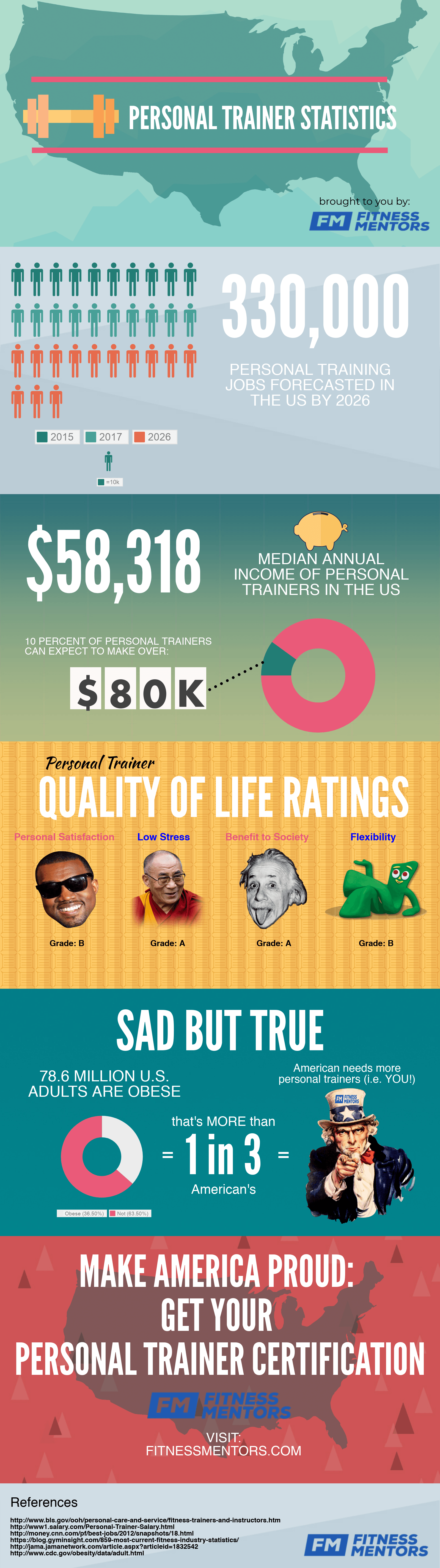
According to the U.S. Bureau of Labor Statistics (BLS), employment of fitness trainers and instructors is projected to grow approximately 14 percent through 2032 significantly faster than the average for all occupations. This translates to tens of thousands of new personal training jobs entering the market each year, with the total number of active positions expected to surpass 330,000 nationwide.
The BLS identifies a broad range of work settings where personal trainers find employment, including:
- Health clubs, fitness centers, and commercial gyms
- Hospitals and rehabilitation centers
- Corporate wellness programs
- Country clubs and resort spas
- Group fitness studios and boutique gyms
- Private in-home training
- Online and virtual coaching platforms
The diversification of training environments especially the rise of remote and hybrid fitness coaching accelerated by the COVID-19 pandemic means that today’s personal trainers have more pathways to build a sustainable career than ever before. Virtual training alone has opened up a national (and even international) client base for trainers willing to work online.
Personal Trainer Salary: What You Can Realistically Earn
Median Annual Income: $58,000–$62,000
According to salary data aggregators including Salary.com, the national average annual salary for a full-time personal trainer in the United States currently sits between $58,000 and $62,000. Roughly half of all personal trainers in the U.S. earn within this range, while the upper quartile typically those with several years of experience, specialty certifications, or high-demand clientele can earn $75,000 to $83,000 or more per year.
It is worth noting that the Bureau of Labor Statistics still publishes an older median pay figure closer to $40,000 for fitness trainers and instructors as a broad category. This figure includes part-time workers and group fitness instructors, which significantly drags down the average. Full-time personal trainers working in premium settings or running independent businesses tend to earn considerably more.
Salary by Experience Level
Experience is one of the strongest predictors of earning potential in personal training. Here is a general breakdown of what trainers can expect at different career stages:
- Entry-level (0–2 years): $35,000–$45,000 per year often working at gyms on an hourly basis while building a client base
- Mid-level (3–5 years): $53,000–$62,000 per year established clientele, potentially supplemented by group fitness or small group training
- Senior/Specialist (5+ years): $65,000–$85,000+ per year typically hold advanced certifications, run independent businesses, or work in clinical or corporate settings
Geography also plays a major role in personal trainer compensation. Trainers working in high cost-of-living metros such as New York City, San Francisco, Los Angeles, Boston, and Seattle routinely command higher session rates and annual salaries than the national median. Using salary lookup tools filtered by zip code is a recommended step when evaluating the income potential in your local market.
How Specialty Certifications Increase Earning Potential
One of the most effective strategies for increasing your income as a personal trainer is to pursue additional specialty certifications beyond your initial CPT credential. Specialty certifications signal expertise to clients and employers, justify higher session rates, and open doors to niche markets that are often underserved and willing to pay a premium.
High-value specialty areas include:
- Pain Management and Corrective Exercise
- Special Populations (seniors, prenatal/postnatal clients, clients with chronic illness)
- Sports Performance and Athletic Conditioning
- Nutrition Coaching
- Group Fitness and HIIT


Personal Trainer Quality of Life and Job Satisfaction
Personal training consistently ranks among the highest-rated careers for overall quality of life. In an assessment by CNN Money and PayScale, personal training was ranked among the top 20 best jobs in America with strong marks across multiple quality-of-life dimensions:
- Personal Satisfaction: B — Trainers consistently report a high sense of fulfillment from helping clients reach meaningful health goals
- Stress Level: A — Compared to most professional fields, personal training is considered low-stress, particularly for self-employed trainers who control their own schedule
- Benefit to Society: A — With chronic disease, obesity, and mental health challenges on the rise, personal trainers are increasingly recognized as essential health professionals
- Flexibility: B — Personal trainers can often set their own hours, choose their clients, and determine where and how they work
Beyond the numerical rankings, personal training offers intangible rewards that are hard to quantify: watching a previously sedentary client complete their first 5K, helping an older adult regain mobility after surgery, or supporting someone through a complete lifestyle transformation. For many trainers, these moments are the real return on their professional investment.
The active nature of the job also means personal trainers are rarely sitting at a desk. Most trainers maintain a high level of physical activity themselves, are immersed in a health-positive environment daily, and frequently report better physical and mental health outcomes compared to sedentary desk-based careers.
The Obesity Crisis in America: Why Personal Trainers Are More Essential Than Ever
According to the Centers for Disease Control and Prevention (CDC), more than 40 percent of American adults are currently classified as obese a figure that has continued to rise steadily over the past two decades. When overweight adults are included, the proportion climbs to over 70 percent of the adult population.
Obesity is directly linked to an increased risk of type 2 diabetes, cardiovascular disease, hypertension, certain cancers, and mental health conditions including depression and anxiety. The economic cost to the U.S. healthcare system is estimated in the hundreds of billions of dollars annually.
Personal trainers occupy a uniquely powerful position in the fight against this public health crisis. Unlike physicians, who typically have only minutes to spend with patients, personal trainers spend hours each week with clients building trust, educating them on movement and nutrition, and providing the accountability and motivation that makes long-term behavior change possible. As trainers continue to expand their knowledge into evidence-based nutrition and lifestyle coaching, their role in preventive health care becomes increasingly significant.
For aspiring trainers, this public health context provides both a moral mandate and a commercial opportunity: the population that most needs help is large, growing, and increasingly aware that professional guidance is a key ingredient in sustainable weight management and lifestyle improvement.
How to Start Your Personal Training Career: Get Certified
The first step toward a career in personal training is earning a nationally accredited certification from a recognized certifying body. The most respected and widely accepted personal training certifications in the United States include:
- NASM-CPT (National Academy of Sports Medicine Certified Personal Trainer) widely regarded as the gold standard for corrective exercise and functional training methodology
- ACE-CPT (American Council on Exercise Certified Personal Trainer) known for its well-rounded, science-based curriculum and emphasis on behavior change
- FM-CPT (Fitness Mentors Certified Personal Trainer) a competitively priced, comprehensive option with strong study support resources
These credentials are recognized by employers, health clubs, and clients nationwide. Holding a certification from one of these bodies demonstrates that you have met a baseline standard of knowledge in exercise science, program design, anatomy, nutrition basics, and client communication.
Once certified, the most ambitious trainers do not stop there. Pursuing continuing education units (CEUs) and specialty credentials throughout your career keeps your knowledge current, expands the client populations you can serve, and provides a concrete competitive advantage in an increasingly credentialed field

Eddie Lester
Read more from the category

Do You Have to Be Certified to Be a Personal Trainer?

How To Get a Personal Trainer Internship in 2026